

Billing Actions (Bill Run, Invoice Sending, and Bulk Crediting)
The Billing area lets your finance team work on many bill groups and invoices at once:
- Bill Run: create invoices for a filtered set of bill groups.
- Invoice Management: review unpaid invoices, then email, credit or void them in bulk.
Who can use it: Tenant Admins and Billing Admins. The Billing item appears in the left menu only for these roles.
| I want to… | Go to |
|---|---|
| Understand when to use a bill run | Why run billing in bulk |
| Invoice a set of bill groups | Run a bill run |
| Email invoices to customers | Email invoices in bulk |
| Clear small balances, such as gateway fees | Credit invoices in bulk |
| Cancel invoices created in error | Void invoices in bulk |
| Check what's eligible | Rules and limits |
Why run billing in bulk
Explanation
Each bill group creates invoices either automatically on its billing schedule or manually (its Create Invoices setting). A bill run lets you invoice many bill groups in one go. It's useful when:
- your team splits the work: one person invoices Enterprise customers, another SMB and Mid-Market;
- customers are invoiced differently: self-serve customers are invoiced automatically, while contracted customers are invoiced manually each week or month after a review.
After a bill run, use Invoice Management to check the new invoices, send them, and tidy up small balances later.
Run a bill run
How-to
-
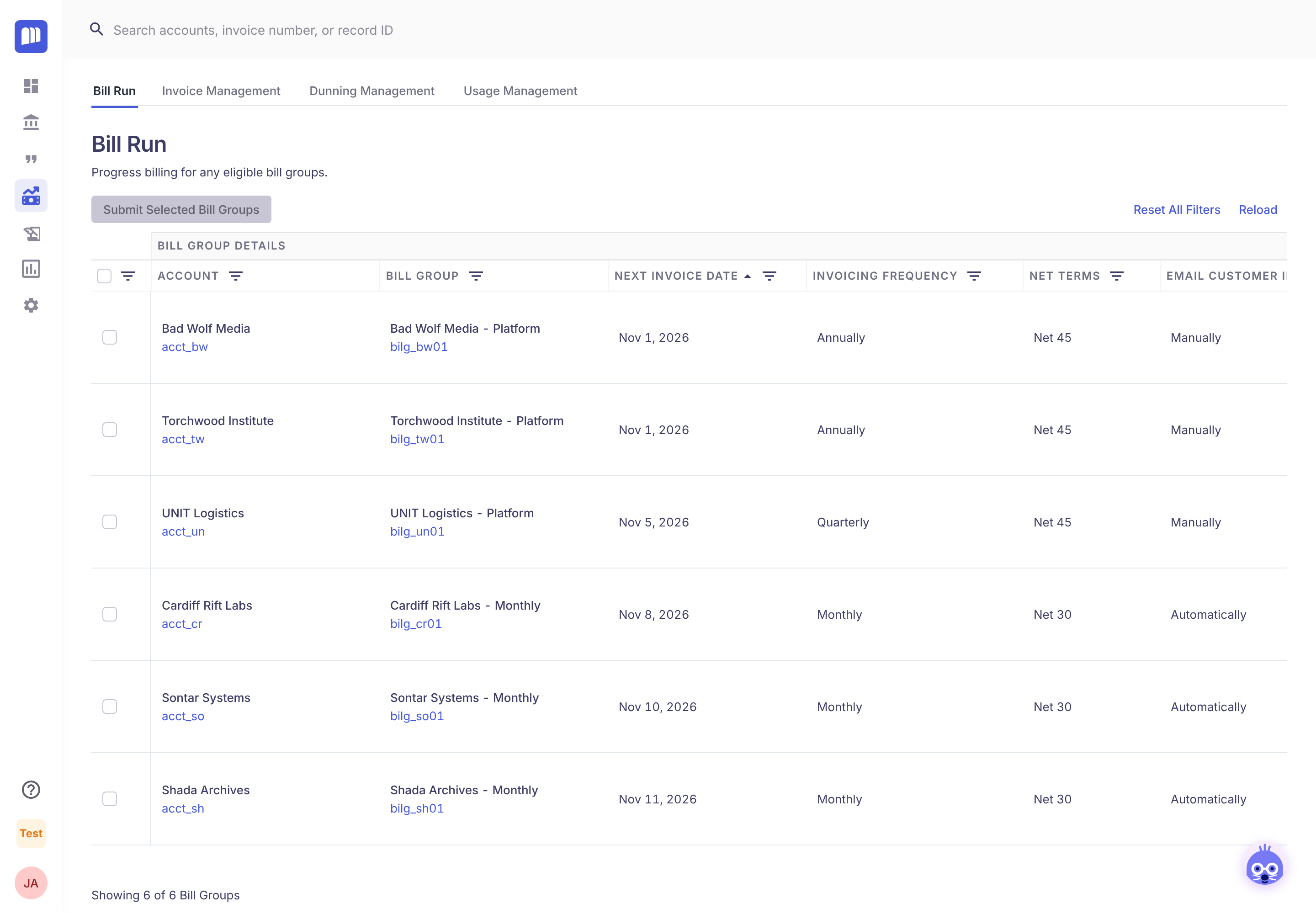
Click Billing in the left menu. The Bill Run tab opens.
It lists every active bill group whose next invoice date has passed. Any Offset from Billing Schedule on the bill group is taken into account.
-
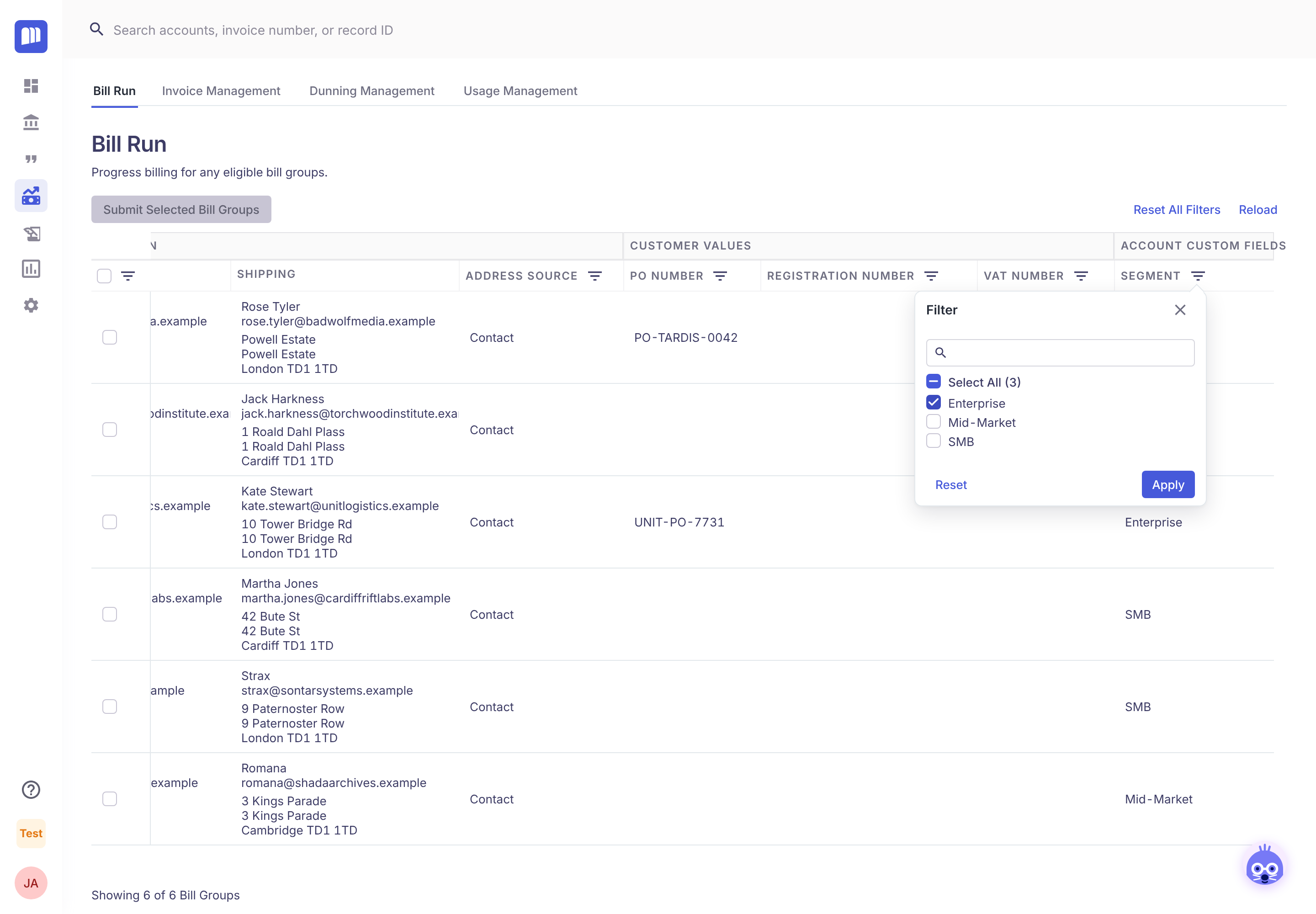
Filter to the bill groups you want. Click the filter icon on any column header: Account, Bill Group, Next Invoice Date, Invoicing Frequency, Net Terms, PO Number and more, including bill group and account custom fields. Click Apply.
-
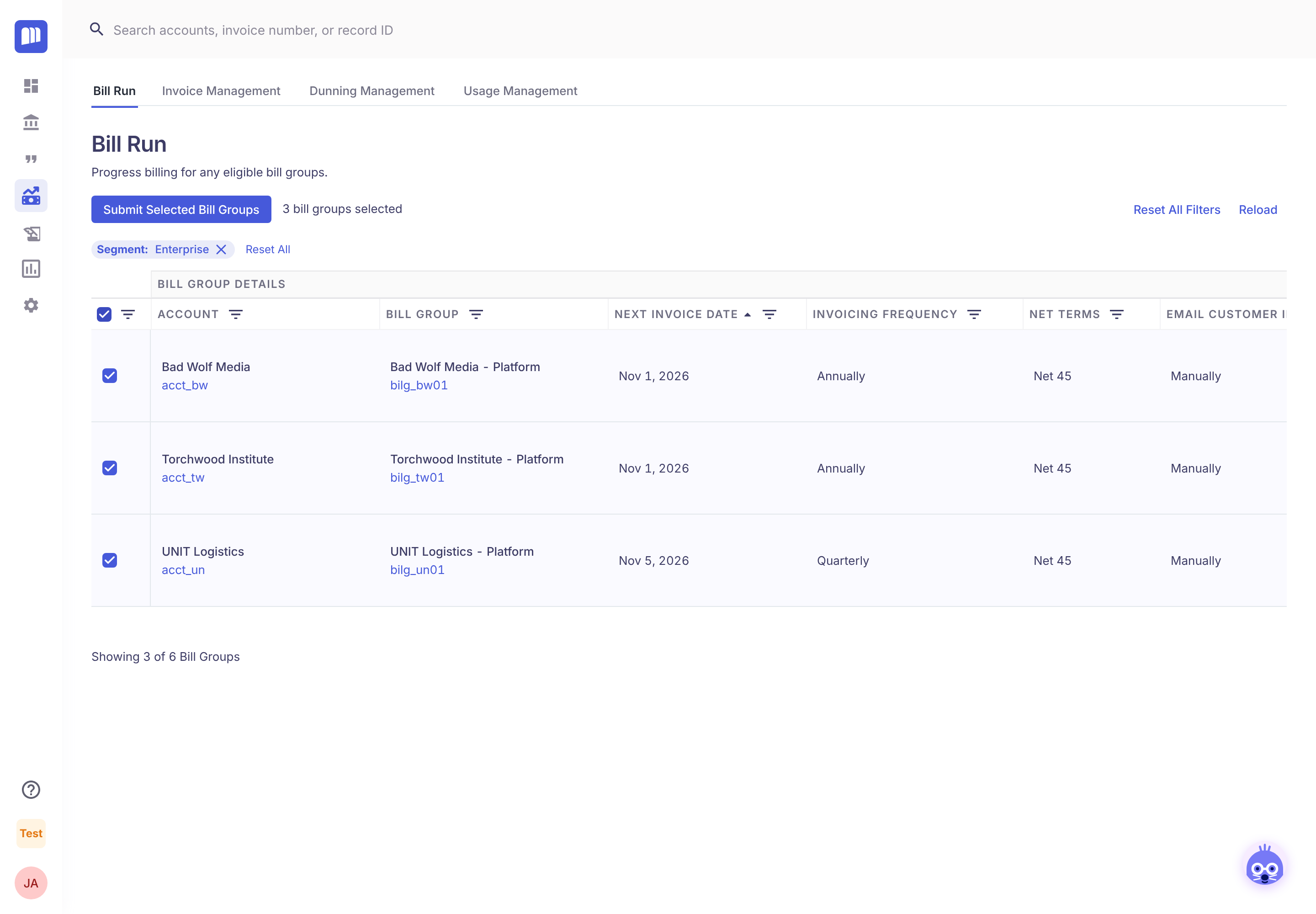
Select bill groups: tick the header checkbox to select everything in the list, or tick rows one by one. The page shows how many are selected.
-
Click Submit Selected Bill Groups. There's no confirmation step.
-
You'll see "Bill run submitted successfully. This can take a few minutes to complete." Invoicing runs in the background. Click Reload to refresh the list.
Tip: Reset All Filters clears every column filter. The footer shows how many bill groups match, for example Showing 3 of 6 Bill Groups.
Email invoices in bulk
How-to
Check invoices before you send them, especially large ones.
-
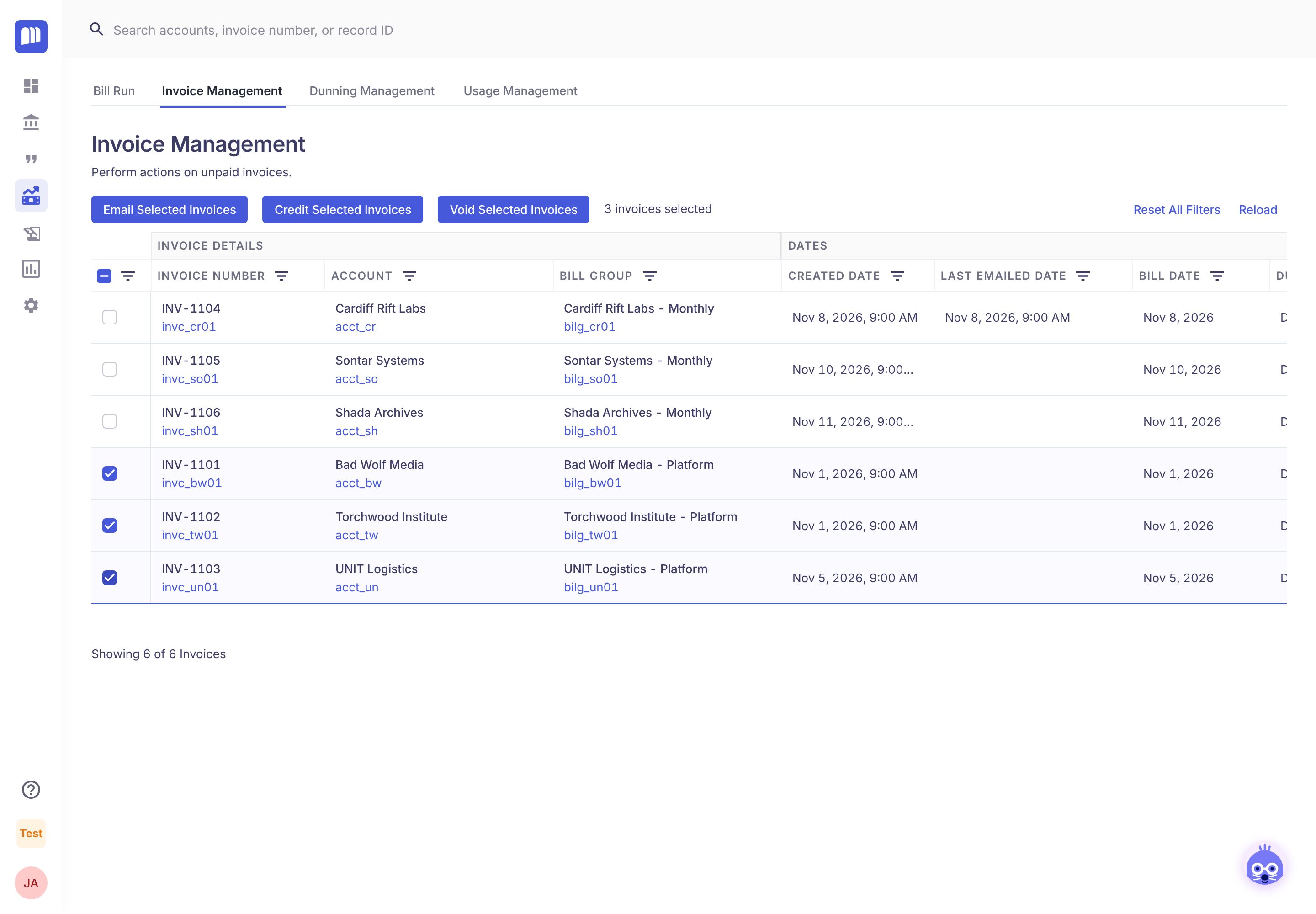
Go to Billing → Invoice Management. It lists every unpaid invoice, oldest due date first.
-
Use the column filters to find the invoices you want, and check the Total Amount and Amount Due.
-
Tick the invoices to send and click Email Selected Invoices.
-
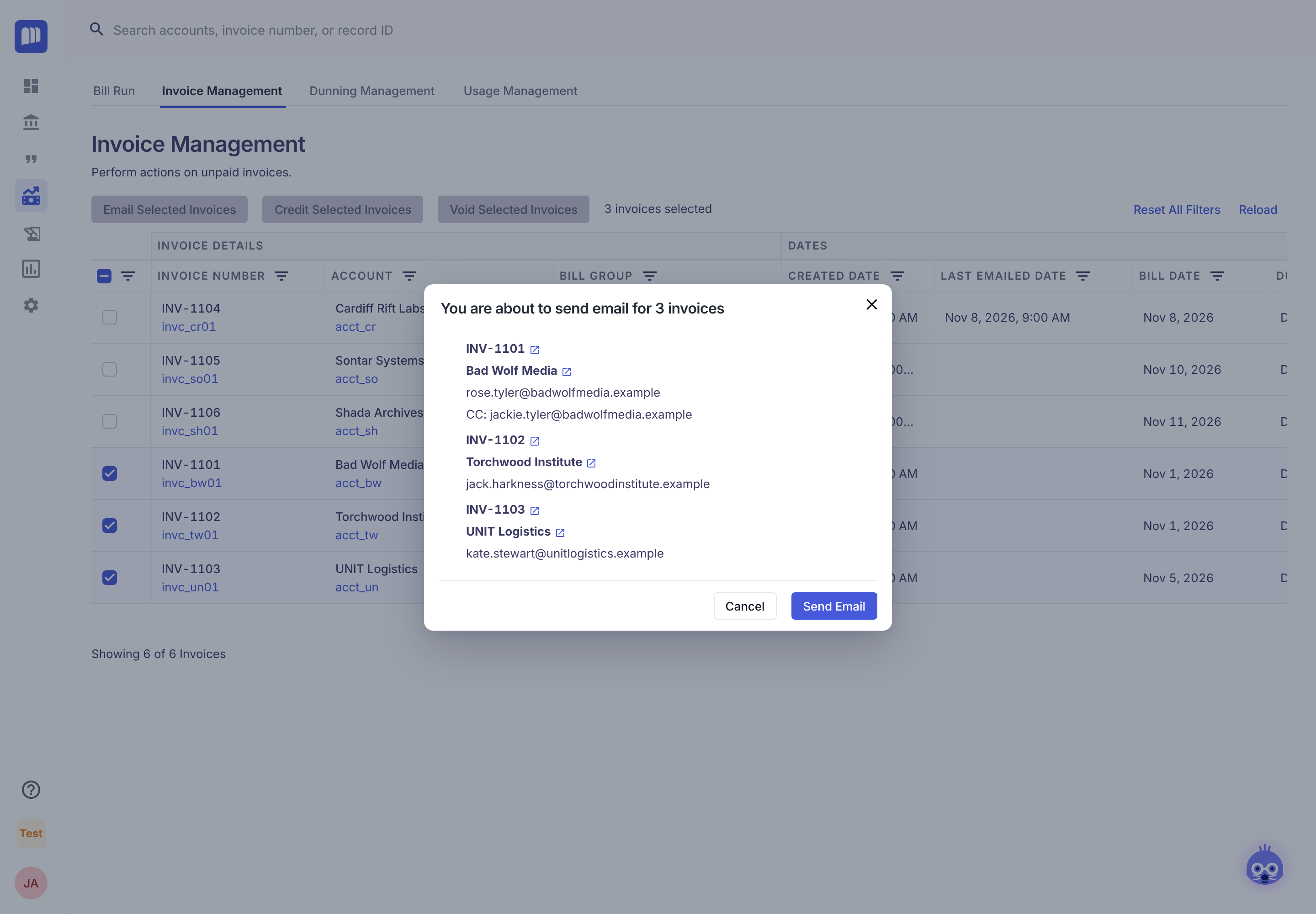
Review the recipients. Each invoice goes to its billing contact, plus the bill group's CC (and BCC) emails. If the bill group collects payment when invoices are sent, the dialog shows "Auto-payment will be attempted on send".
-
Click Send Email, then confirm with Send Emails. One email is sent for each invoice.
You'll see progress and a summary, for example "All 3 invoices sent". If some fail, MonetizeNow tells you how many.
Draft invoices can't be emailed. Only unpaid invoices appear here.
Credit invoices in bulk
How-to
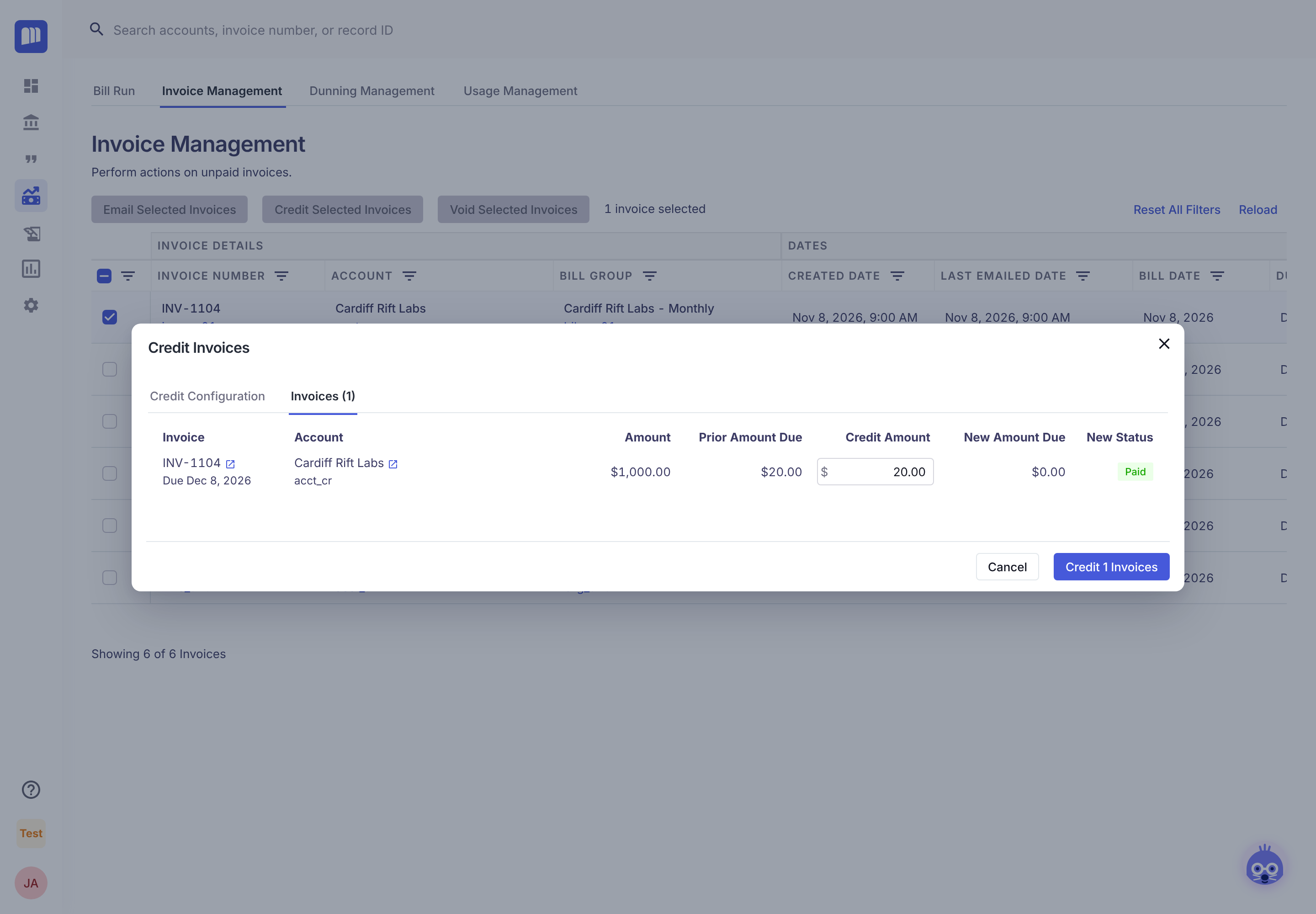
When to use it: a customer's payment arrives short because the payment gateway kept a fee. For example, Cardiff Rift Labs pays a $1,000 invoice and the gateway keeps $20. MonetizeNow records a $980 payment, so $20 stays due. Bulk crediting clears these leftover balances on many invoices at once.
-
In Invoice Management, filter to the invoices with small balances. Sorting or filtering on Amount Due helps.
-
Tick them and click Credit Selected Invoices.
-
On the Credit Configuration tab:
- Name: defaults to Bulk invoice credit;
- Reason (required): for example Payment gateway fee deducted from payment;
- any credit custom fields.
-
On the Invoices tab, check each row. Credit Amount defaults to the invoice's full amount due; you can lower it. New Amount Due and New Status (Paid or Unpaid) update as you type.
-
Click Credit n Invoices, check the total for each currency, and click Create Credit.
MonetizeNow creates one credit per invoice and applies it straight away. The credit can't be refunded and doesn't expire.
Check the amounts. Because the credit defaults to the full amount due, crediting an invoice with a large balance clears all of it. Untick any invoice you didn't mean to include.
Void invoices in bulk
How-to
Use this to cancel invoices created in error.
- In Invoice Management, tick the invoices and click Void Selected Invoices.
- Choose a Reason Code:
- Generated in Error
- Duplicate Invoice
- Incorrect Amount
- Incorrect Tax
- Migration Data Correction
- Other
- Add an Internal Comment. It's required for Other.
- Click Void n Invoices.
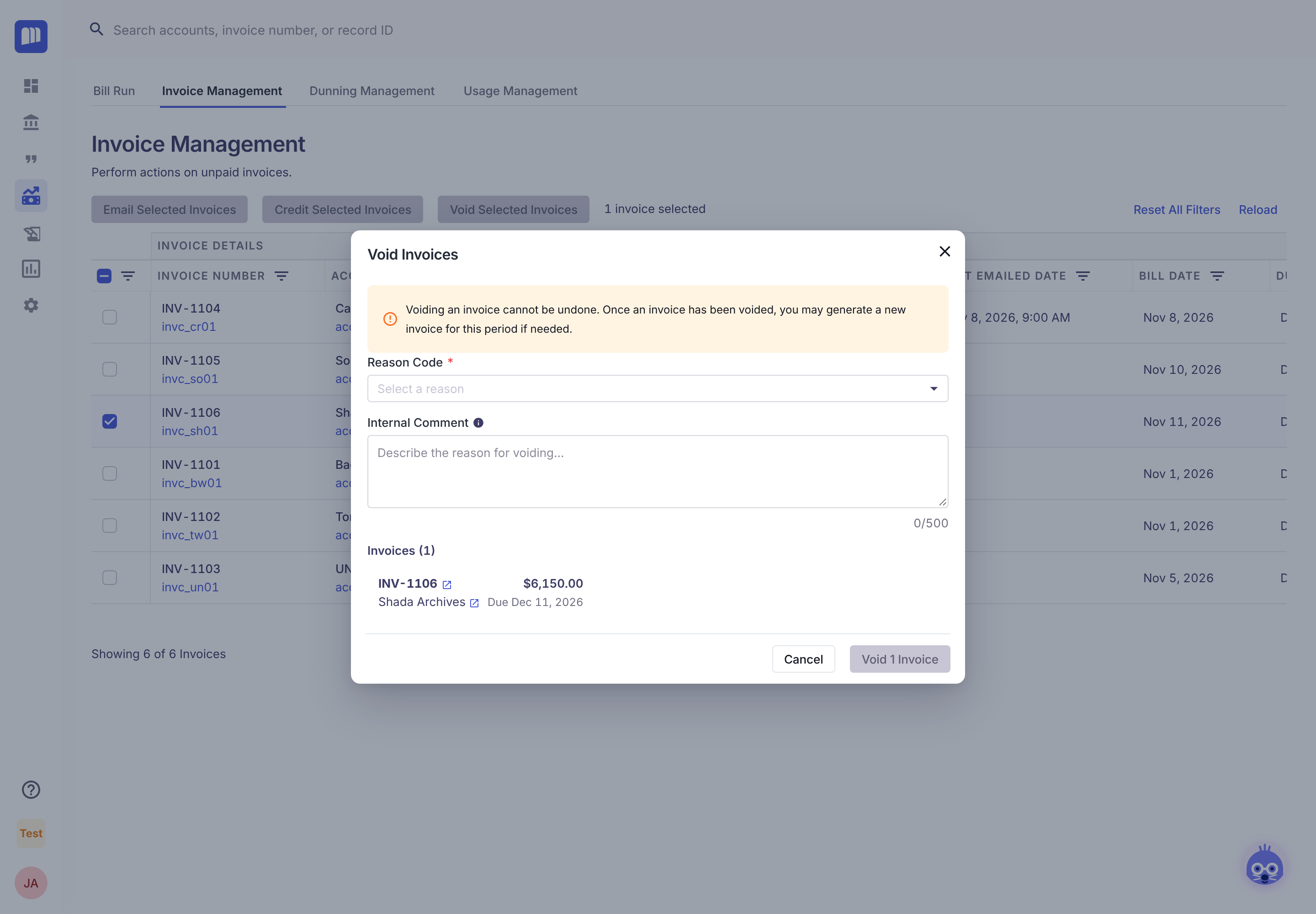
Voiding can't be undone. Once an invoice is voided, you can generate a new invoice for that period if needed. Only unpaid invoices with no credits, payments or write-offs applied can be voided.
Rules and limits
Reference
| Rule | |
|---|---|
| Access | Tenant Admin and Billing Admin |
| Bill Run shows | Active bill groups whose next invoice date (plus any offset) has passed |
| Bill Run filters | Every column, plus bill group and account custom fields |
| Bill Run confirmation | None. It starts as soon as you click Submit Selected Bill Groups. |
| Invoice Management shows | Unpaid invoices only |
| Email recipients | The invoice's billing contact, plus the bill group's CC and BCC emails |
| Bulk credit amount | Defaults to the full amount due. Must be more than 0 and no more than the amount due. |
| Bulk credit type | A credit (not a credit note), applied immediately, not refundable, no expiry |
| Void | Unpaid invoices with nothing applied; can't be undone |
The Billing area also has Dunning Management and Usage Management tabs, covered on their own pages.
Related
Updated 6 days ago