

Avalara
Connect MonetizeNow to Avalara AvaTax to calculate sales tax on your invoices automatically. MonetizeNow sends each invoice's products and addresses to Avalara, and adds the tax Avalara returns to the invoice.
| I want to… | Go to |
|---|---|
| Get Avalara ready | Before you start |
| Connect MonetizeNow to Avalara | Connect to Avalara |
| Make sure products are taxed correctly | Map your products |
| Set up tax-exempt customers | Set up tax exemptions |
| Understand what's sent and when | How tax is calculated |
| Check it works | Test your setup |
| Fix an invoice with a tax error | Fix a tax calculation error |
| Solve a problem | Troubleshooting |
Best practice: connect an Avalara Sandbox account and test with a test company first, before you connect Production.
Before you start
How-to. In Avalara.
- Make sure your Avalara company is set up for the places where you collect tax.
- Generate a license key and note your Account Number and Company Code.
- Add your products to Avalara in What You Sell, with the right tax treatment. You'll match them to MonetizeNow products in Map your products.
Connect to Avalara
How-to. Requires access to tax settings.
-
Click the gear icon to open Settings, then select Tax under Integrations.
-
On the Avalara card, click Connect to Avalara.
-
Fill in the form:
Field What to enter Account Number Your Avalara account number Environment Sandbox or Production. Must match the account and license key. Tax Calculation Field The product field sent to Avalara as the Item Code. See Map your products. Default Tax Item Code. Company Code Your Avalara company code. If you have only one company in Avalara, use DEFAULT.License Key Your Avalara license key Post and Commit Transactions On (default): tax is recorded in Avalara as committed sales invoices. Off: transactions are sent as Sales Orders, which Avalara doesn't record. Useful for testing. Apply to Which Legal Entities All Legal Entities, or Specific Legal Entities to use this connection only for the legal entities you choose 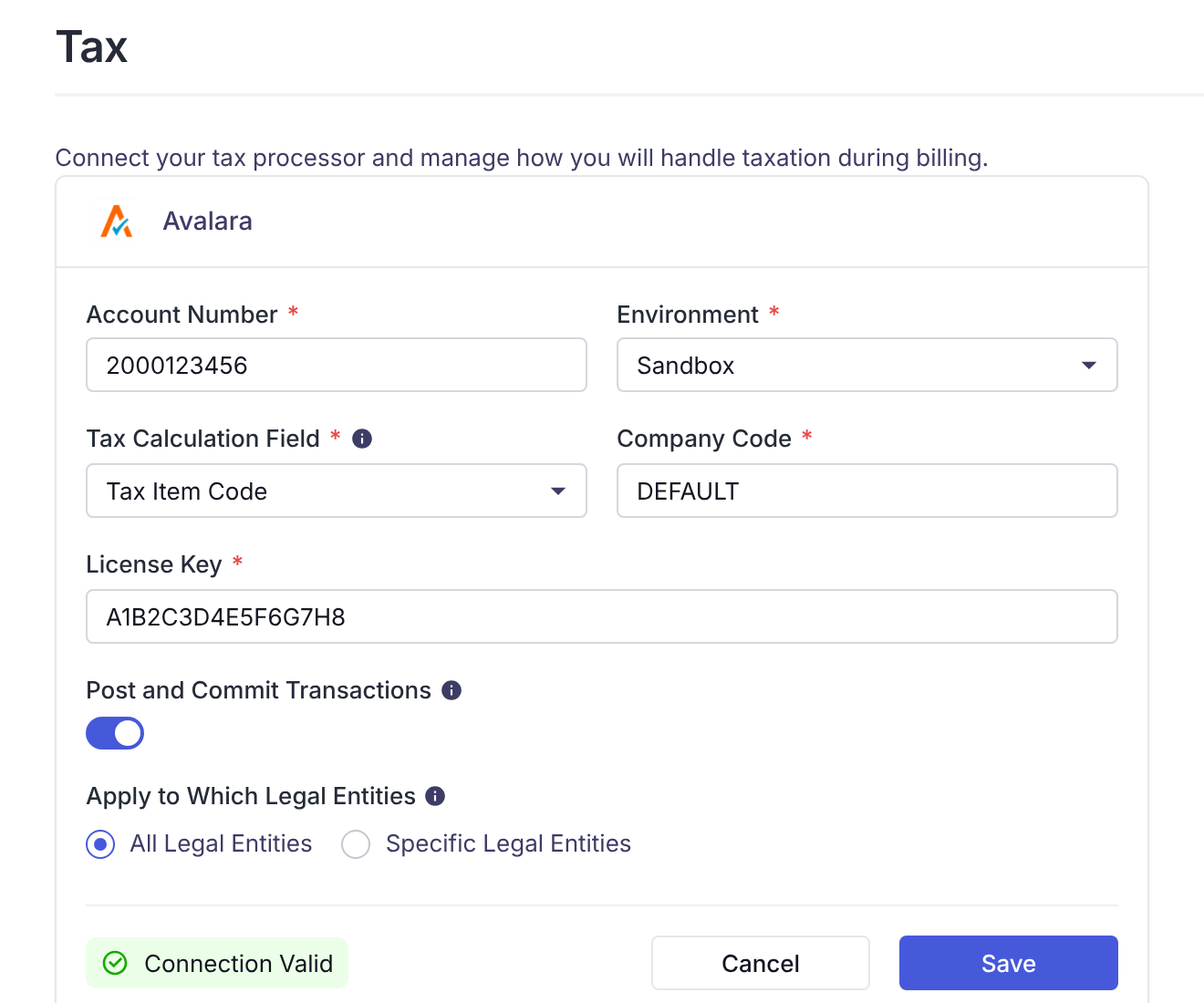
-
Click Test Connection. Save is enabled only after the test shows Connection Valid for the values you entered.
-
Click Save.
The Avalara card now shows Active and your settings, with the license key masked.
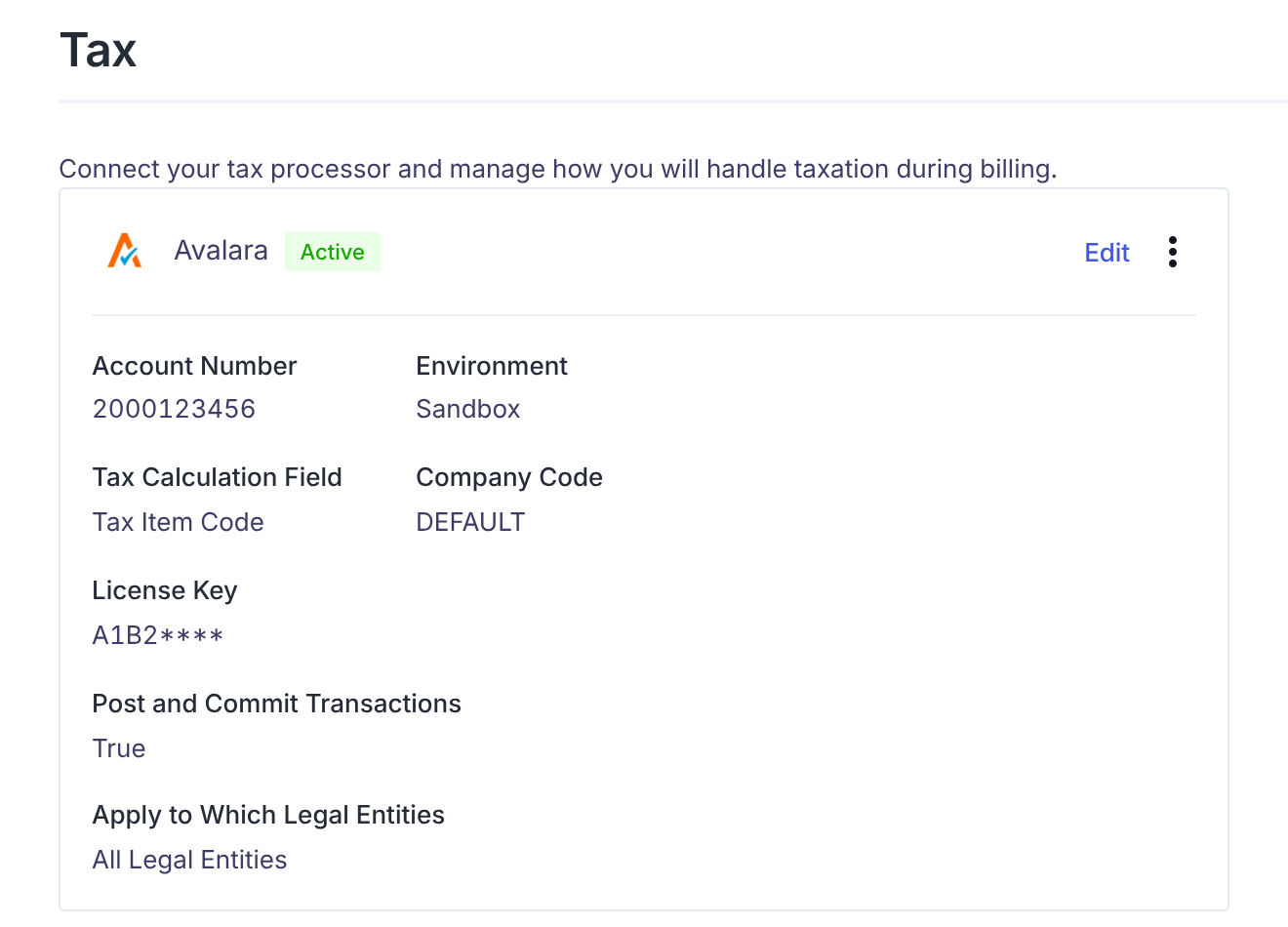
Manage the connection from the card's ⋮ menu:
- Verify Connection: re-test the saved settings;
- Disable Connection / Enable Connection: pause or resume tax calculation;
- Delete: remove the connection.
Click Edit to change settings.
Map your products
How-to
Avalara decides how to tax each line by its Item Code. MonetizeNow sends one product field as the Item Code. Choose that field with Tax Calculation Field:
| Option | Use it when |
|---|---|
| Tax Item Code (default) | Several MonetizeNow products share one Avalara item with identical tax treatment |
| SKUs | Your products already have SKUs you also use in Avalara |
| Custom ID | You identify products by an ID from another system |
| Product ID | You use MonetizeNow's own product IDs in Avalara |
Then, for each product:
- In MonetizeNow, open the product in Product Catalog → Products and fill in the field you chose. This example uses Tax Item Code.
- In Avalara, create the item in What You Sell, with its Item Code set to exactly the same value.
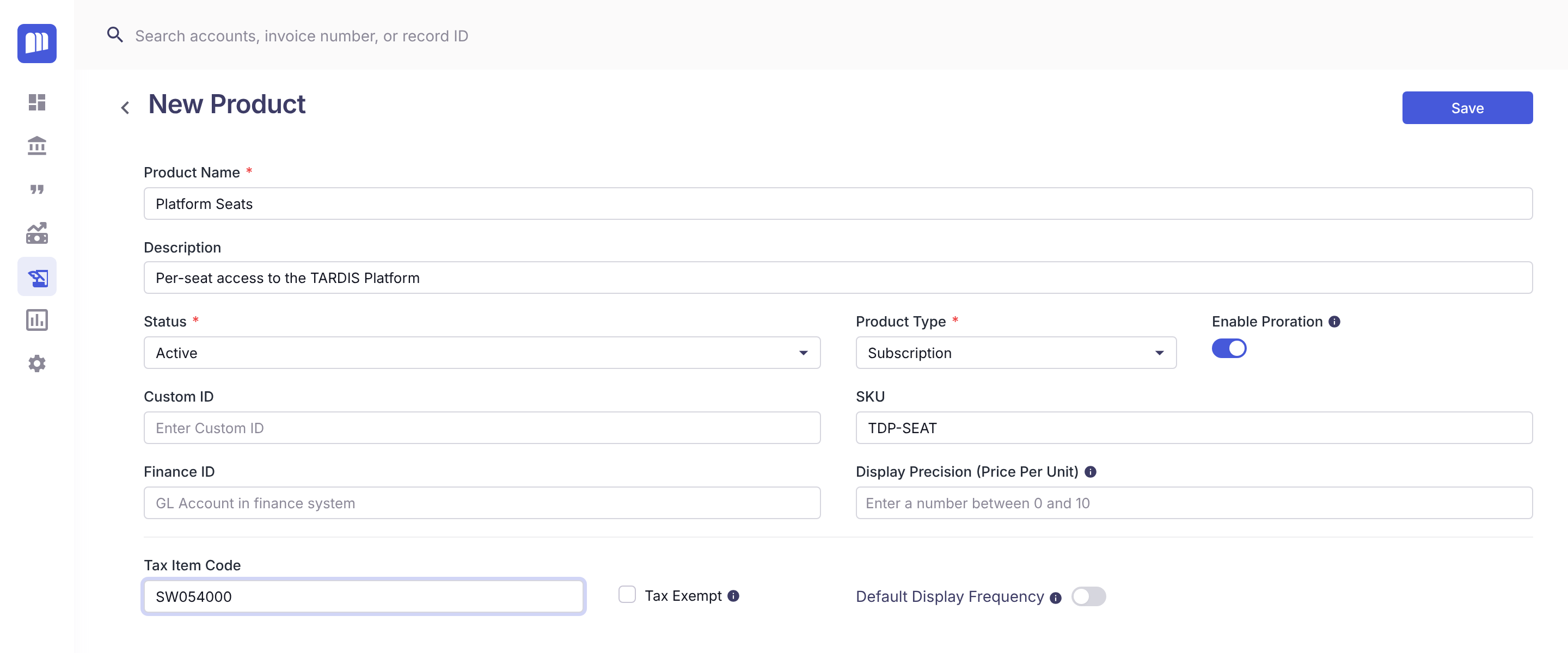
Every taxable product needs a value. If any product on an invoice is missing the chosen field, MonetizeNow doesn't calculate tax, and the invoice shows a product-mapping tax error. Map new products before you sell them.
Products that should never be taxed: tick Tax Exempt on the product. "If selected, this product will not be sent to the tax provider during tax calculation." It's still best practice to set up every product in Avalara and control taxability there.
Set up tax exemptions
How-to
For customers who are exempt from tax:
- Open the account and select the Details tab, then click Edit.
- Enter the Tax Exemption Number and choose a Tax Exemption Reason (for example Resale, Charitable/Exempt Org, Federal Gov or Educational Org).
- Save.
Both values are sent to Avalara with every invoice for that account.
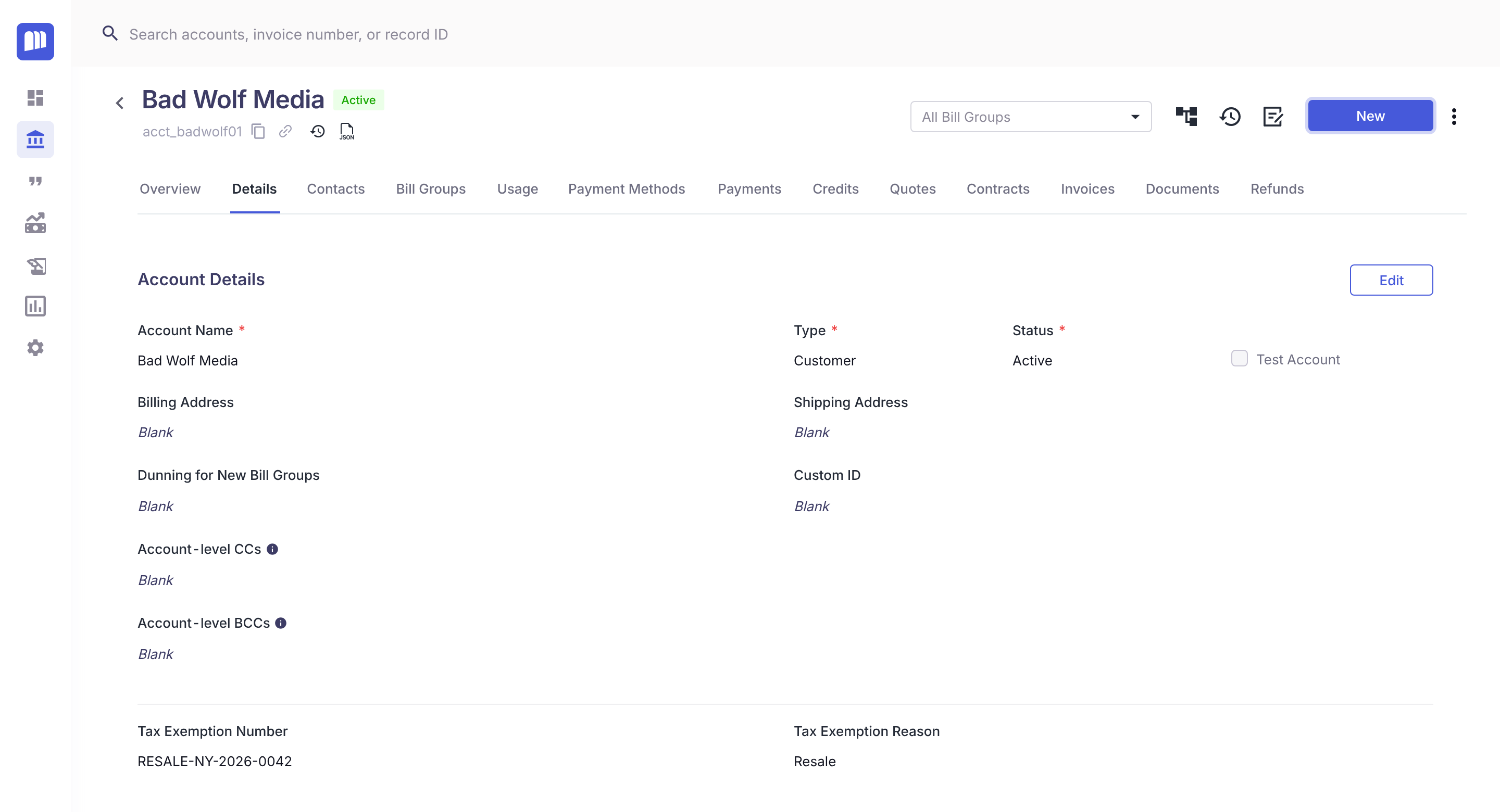
These fields only appear when an Avalara connection is active.
Exemption certificates: create the customer in Avalara and upload the certificate there. Use the MonetizeNow account ID (for example acct_badwolf01) as the Customer Code in Avalara, so certificates match the transactions MonetizeNow sends.
How tax is calculated
Explanation
What's sent to Avalara
| Avalara field | Comes from |
|---|---|
| Customer Code | The MonetizeNow account ID |
| Item Code | The product field chosen in Tax Calculation Field |
| Ship To | The invoice's shipping address |
| Ship From | The address of your legal entity on the invoice |
| Exemption number / reason | The account's Tax Exemption Number and Tax Exemption Reason |
| Document date | The date the invoice was created |
| PO number | The invoice's PO number |
Tax-exempt products aren't sent. If every product on an invoice is tax exempt, the invoice has no tax and nothing is sent to Avalara. Invoices on test accounts are never taxed.
Where the shipping address comes from
The shipping address decides the tax jurisdiction, so it needs to be accurate:
- On a quote, the primary contact becomes the bill group's shipping contact when the quote is processed.
- The bill group's shipping contact and address flow onto each invoice.
- The invoice's shipping address is sent to Avalara.
If the bill group sources addresses from Account Addresses (synced from your CRM), the account's shipping address is used instead.
When tax is calculated
| Invoice | When tax is calculated |
|---|---|
| Recurring invoices (from a contract) | When the invoice is created. It's committed in Avalara straight away (when Post and Commit Transactions is on). |
| One-time invoices | Estimated while the invoice is a draft, then committed when you Finalize it |
Credit notes
When you create a credit note from an invoice, including through Credit and Rebill:
- MonetizeNow sends the credit lines to Avalara as negative amounts;
- it uses the address from the original invoice, not the account's latest address;
- it uses the original invoice's date for tax, so exemptions and product classifications match the invoice.
If you back-date an exemption or product classification change in Avalara, a credit note can carry more or less tax than the original invoice. Keep these changes forward-looking.
Voiding a credit note also voids its transaction in Avalara.
Voiding invoices: voiding an invoice in MonetizeNow doesn't update Avalara yet. This is coming soon. Until then, to reverse the tax on an invoice in Avalara, issue a credit note.
Test your setup
How-to. Use your Avalara Sandbox.
- Connect Avalara as described above, with Environment set to Sandbox.
- Make sure your test products are mapped and exist in Avalara.
- Create a quote and add products.
- Choose a primary contact (it becomes the shipping contact) with a full, valid address in a jurisdiction where you collect tax.
- Process the quote.
- Open the account's Invoices tab, open the invoice and check the tax.
- In Avalara, open Transactions to see the matching transaction and its details.
Fix a tax calculation error
How-to
If Avalara can't calculate tax, the invoice stays in Draft and shows a red banner explaining why.
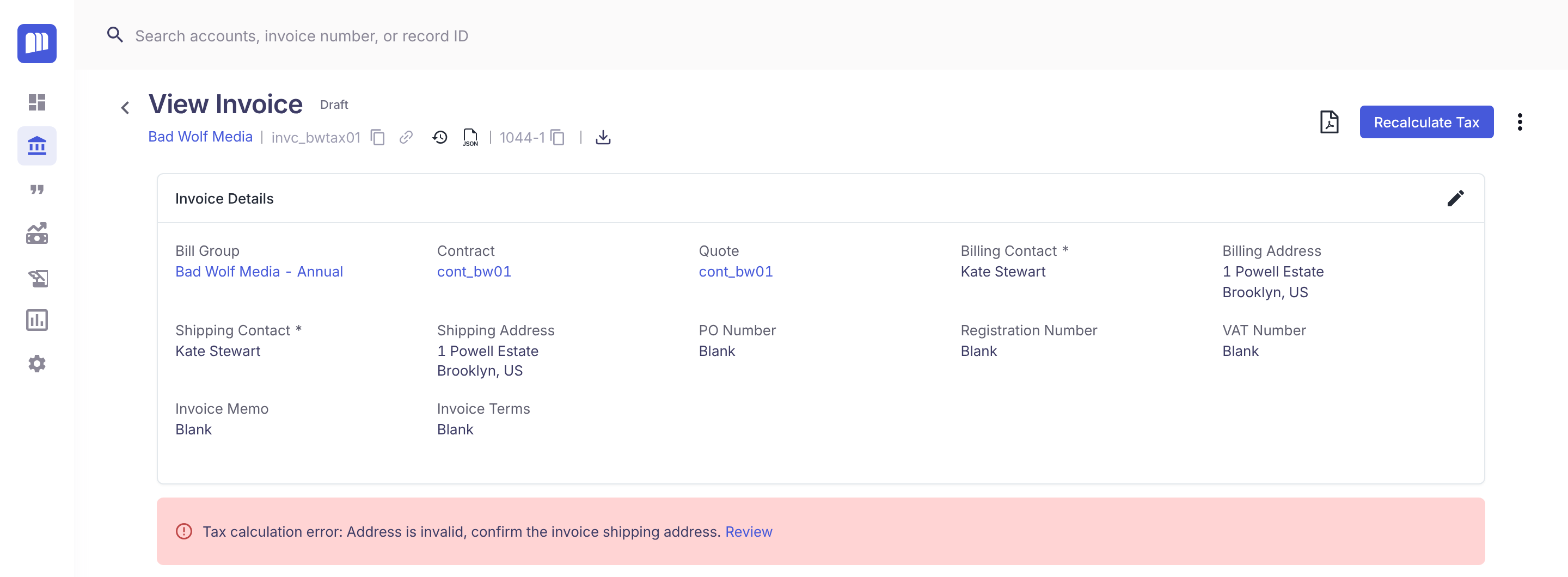
While the error is open:
- the invoice can't be emailed or paid;
- no more invoices are created for that bill group until you fix it or finalize the invoice.
| Banner says | What to do |
|---|---|
| Address is invalid, confirm the invoice shipping address. | Click Review and correct the shipping contact or address |
| Product mapping not configured correctly with your tax provider. | Check the product has a value in the field set as Tax Calculation Field, and that the same Item Code exists in Avalara |
| Authentication failure, confirm your API key. | Open Settings → Tax, then use ⋮ → Verify Connection or Edit to fix the account number, environment or license key |
| Any other message | Check the message, and the transaction in Avalara, for details |
To fix it:
-
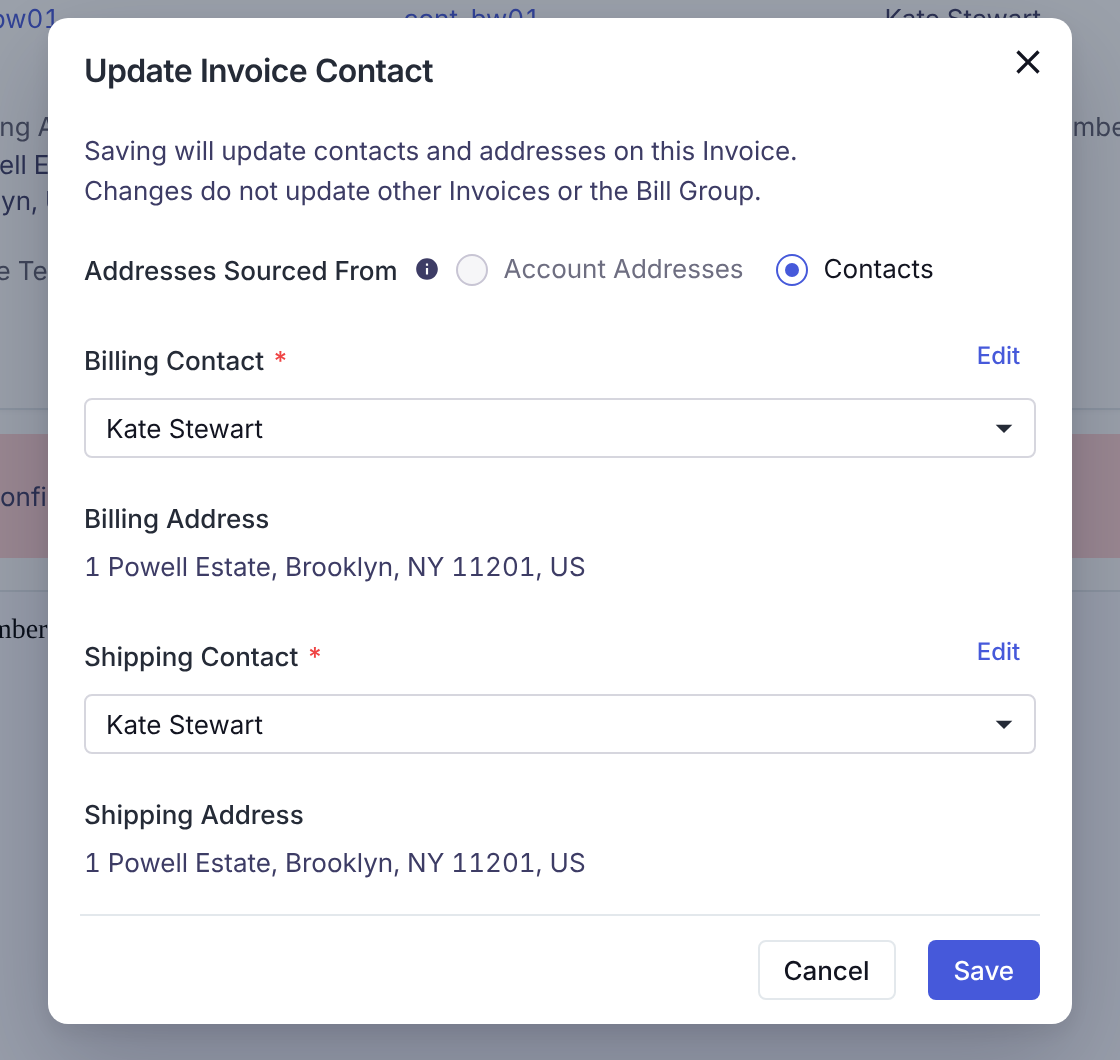
Click Review on the banner, if shown. It opens Update Invoice Contact, where you can choose a different contact or click Edit to correct the address. Click Save.
Changes apply to this invoice only. They don't update other invoices or the bill group, so also fix the contact on the bill group to keep future invoices right.
-
Click Recalculate Tax at the top of the invoice.
-
When tax calculates, finalize the invoice as usual.
Finalize without tax (not recommended): open the invoice's ⋮ menu and choose Finalize with Tax Error. The invoice is finalized without tax. This can't be undone.
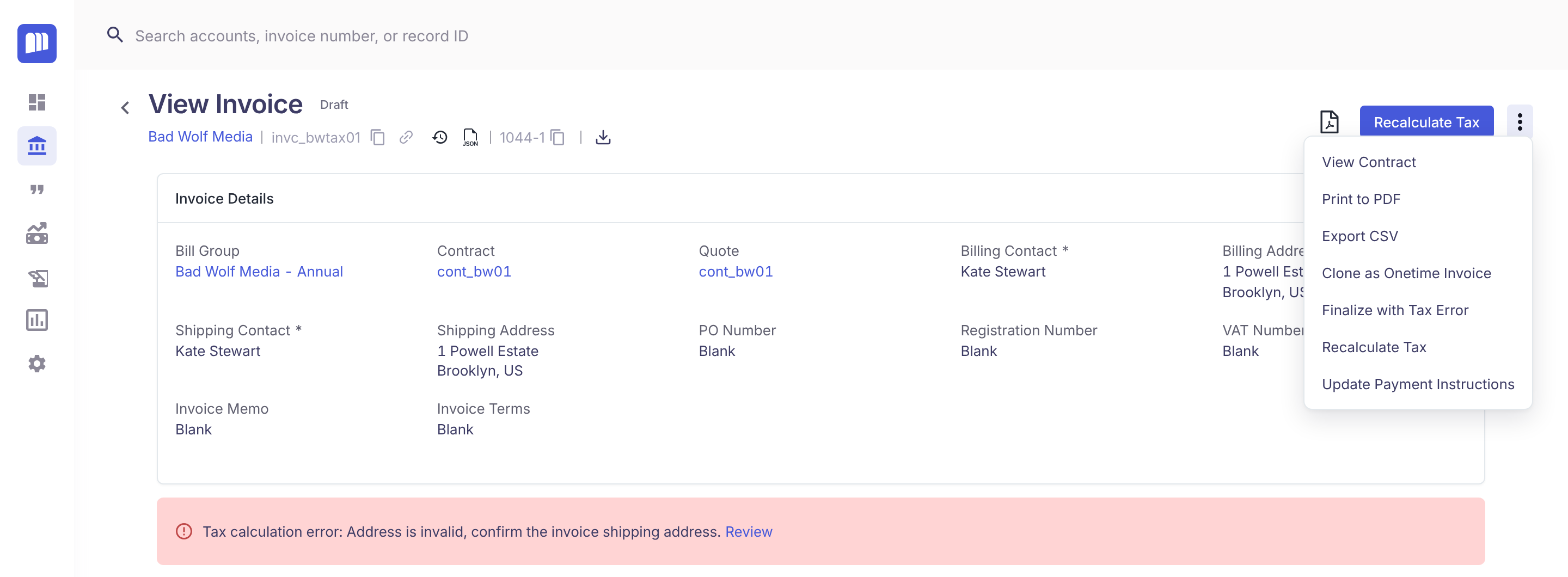
Recalculate Tax is available while the invoice is a draft. Tax can't be recalculated once the invoice has a payment or a credit applied. To correct tax on an invoice that's already been finalized, issue a credit note, or use Credit and Rebill.
Troubleshooting
Reference
An invoice has no tax, but I expected tax.
- Check the account isn't a Test Account.
- Check the products aren't marked Tax Exempt.
- Check the invoice's shipping address is complete and correct.
- In Avalara, check the jurisdiction's tax calculation start date is on or before the invoice date.
- Review the transaction in Avalara's Transactions for calculation details.
The address on an invoice, and so the tax, is wrong. If your addresses come from your CRM (Salesforce or HubSpot), correct them there so the fix flows into MonetizeNow. Avalara offers CRM plugins that validate addresses as they're entered, to prevent errors. Then fix the current invoice with Update Invoice Contact and Recalculate Tax.
How are freight and non-standard items taxed? List them as their own products and line items on contracts and invoices. Then set their tax treatment in Avalara like any other item.
Related
Updated 10 days ago